

Before I founded Port (and my previous startup), I actually spent some time at a VC firm in Israel called TLV Partners.
I distinctly remember working on and seeing posts on Linkedin mapping out industries. It was fun debating who should be in which category and where an industry was heading.
Now, I’m in the unique position of seeing the industry from a completely different perspective.
When we started Port, I would have said that we were in the DevOps or platform engineering industry. In a sense we still are, but we’re now helping platform engineers build the layer above it: agentic engineering.
So that’s the industry I wanted to map out.
In our mission of moving engineering from manual to autonomous, we’re seeing companies introduce agents to every part of the SDLC - from planning all the way to operating.
With that huge influx of agents comes new needs. Those agents need infrastructure. It’s not the same infrastructure as DevOps though. It’s agentic engineering infrastructure that is specifically designed for agents like context, guardrails, and orchestration.
For that reason you’ll see in the map I’ve separated everything into agents and agentic engineering infrastructure.
While researching, I came to some other conclusions about the market:
Coding agents get most of the attention but the market for AI that operates across the entire SDLC is actually much bigger than the market for coding agents. The internet goes wild every time a new coding model comes out which makes sense. But harnessing that model to make it actually operate and be useful beyond coding is where most of the work lies. That’s why I think the market for the harness will be bigger than the models.
AI won’t replace the platform stack. It adds a new layer on top. Agents + agent infrastructure sit above the existing DevOps/cloud/observability foundation. Agentic engineering is a mix of deterministic (DevOps layer) and non-deterministic (Agentic) flows.
It looks like there aren’t any deploy agents on the market which makes sense. Deployment itself should not be left to agents. But I think there’s room in the market for risk assessment agents that decide which deployment strategy to take.
“Agent Experience” replaces “Developer Experience” as the design target. When choosing which tools or infrastructure to work with, the question is no longer “which ones do our developers like?”. Instead, when you plan your stack, you will ask your agents to find tools for you. They will choose tools that work best for them. If a tool doesn’t have a strong MCP server, an agent will find an alternative that does. UI is not nearly as important as data/context.
You might ask: why is Port in so many categories? That’s because platform engineers and platform engineering will be critical to building out the agentic engineering infrastructure blocks. It may not be fully clear to everyone yet, but based on what our customers tell us every day, controlling agentic chaos and agent sprawl will 100% be the platform team’s responsibility.
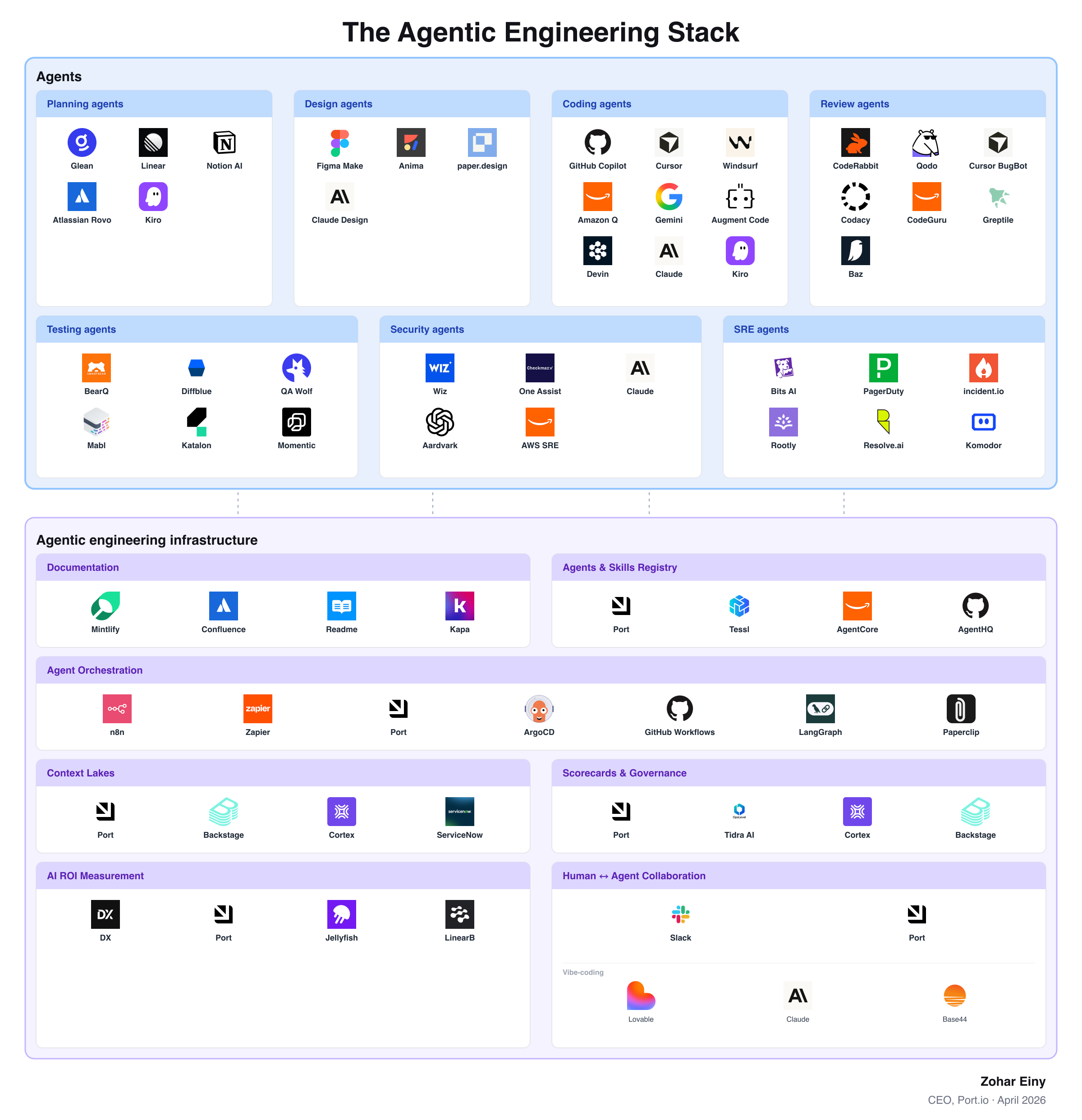
As always, I'd love to hear what you think. Feel free to reply and let me know which agents and infrastructure you’d choose when building your stack.